
Quarterly Installments Explained for Government Agriculture Loans
Government agriculture loans have become an important support system for farmers in Pakistan, especially in Punjab. These loans help farmers purchase tractors, farm machinery, seeds, fertilizers, irrigation systems, and other essential inputs needed to improve agricultural productivity. To make repayment easier for farmers, most government agriculture loans are offered with a quarterly installment system instead of monthly payments.
Many farmers hear the term “quarterly installments” but do not fully understand how it works. Some farmers assume it means higher payments, while others think it gives unlimited time for repayment. Due to this confusion, mistakes are often made, leading to missed payments, penalties, or unnecessary stress.
This article explains quarterly installments for government agriculture loans. It covers how quarterly installments work, why the government uses this system, how amounts are calculated, what happens if an installment is delayed, and how farmers can manage repayments smoothly.
What Are Quarterly Installments?
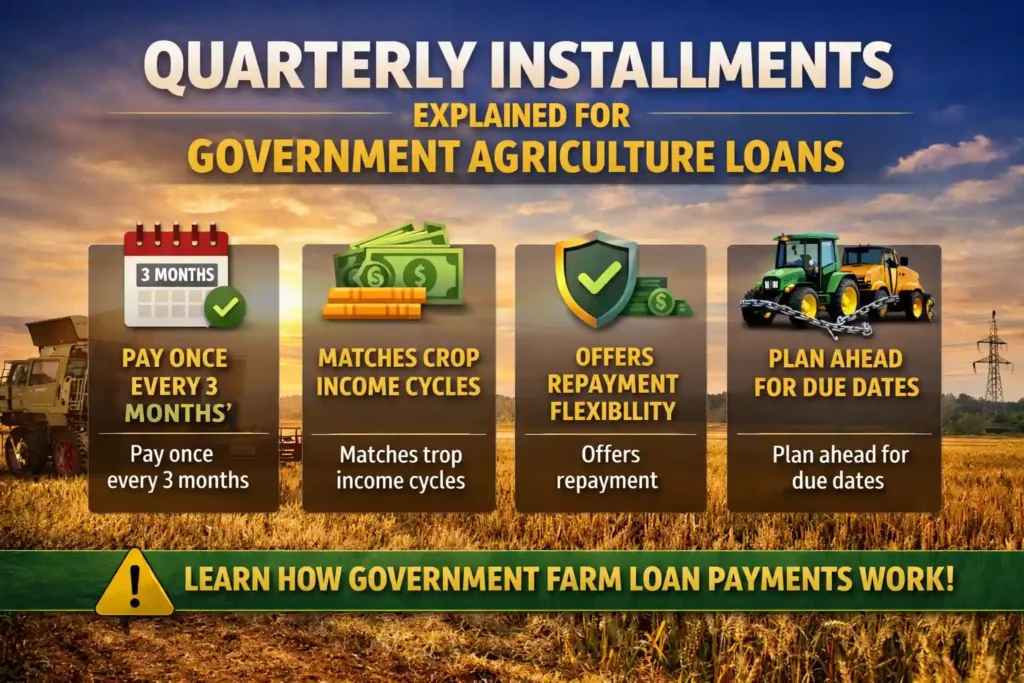
Quarterly installments mean that the borrower pays the loan amount once every three months instead of paying monthly. In one year, there are four installments, each covering a three-month period.
This system is designed specially for agriculture loans because farming income is seasonal. Farmers usually earn money after harvesting crops, not every month. Quarterly installments allow farmers to repay loans when they are more financially stable.
In simple terms, instead of paying 12 small installments in a year, farmers pay 4 planned installments.

Why Government Agriculture Loans Use Quarterly Installments
The government understands that agriculture is different from salaried jobs or businesses. Crop cycles take time, and income comes at specific seasons.
Quarterly installments are used because:
- Farmers receive income after harvest
- Crop seasons are usually 3 to 6 months long
- Monthly payments can create unnecessary pressure
- Weather and market conditions affect cash flow
This system gives farmers breathing space and aligns repayment with real agricultural income patterns.

How Quarterly Installments Are Calculated
Quarterly installment amounts depend on:
- Total loan amount
- Loan duration (years)
- Markup or subsidy (if applicable)
- Grace period (if given)
For example, if a farmer takes a loan for five years, the total number of installments will usually be 20 quarterly installments.
The loan amount is divided equally across these installments. If markup support or interest-free benefits apply, the installment remains stable and predictable.

Grace Period and Quarterly Installments
Many government agriculture loans offer a grace period, especially for machinery or long-term projects.
A grace period means:
- The farmer does not pay installments immediately
- Repayment starts after a few months
- It allows time to generate income
During the grace period, quarterly installments do not start. Once the grace period ends, the regular quarterly schedule begins.
This is very helpful for farmers investing in machinery or new farming methods.

Payment Schedule in Quarterly Installments
Once the loan is approved, the bank provides a clear repayment schedule. This schedule mentions:
- Installment due dates
- Amount per installment
- Total number of installments
- Final repayment date
Farmers should carefully note these dates. Missing even one quarterly installment can create problems, especially because the next installment comes after three months, not one month.
Difference Between Quarterly and Monthly Installments
Many farmers compare quarterly installments with monthly ones.
Quarterly Installments
- Paid every three months
- Larger amount per installment
- Matches crop income cycles
- Fewer payment dates to remember
Monthly Installments
- Paid every month
- Smaller amount per payment
- More frequent reminders
- Less suitable for seasonal income
For agriculture loans, quarterly installments are usually more practical and farmer-friendly.
What Happens If a Quarterly Installment Is Missed?
Missing a quarterly installment does not mean immediate default, but it is a serious issue.
Initially:
- The installment is marked as overdue
- The bank may send reminders
- Phone calls or notices may follow
If the delay continues:
- Late payment charges may apply
- Credit history may be affected
- Subsidy or markup support may be paused
Because quarterly installments are less frequent, missing one installment means a longer delay in repayment.
Impact on Government Subsidy or Support
Many government agriculture loans include subsidies or interest support.
If quarterly installments are not paid on time:
- Government support may be temporarily stopped
- The loan may convert to a normal loan
- Additional financial burden may increase
This is why timely payment is important even when installments are quarterly.
Can Quarterly Installments Be Rescheduled?
Yes, in genuine cases, rescheduling is possible.
Banks may consider rescheduling if:
- Crop failure occurs
- Natural disasters affect farming
- Market prices collapse
- Serious personal emergencies arise
Farmers must approach the bank early and provide valid reasons. Delaying communication only worsens the situation.
Common Misunderstandings About Quarterly Installments
Many farmers have wrong assumptions, such as:
- Thinking quarterly installments mean no strict deadlines
- Believing missing one installment has no effect
- Assuming government loans cannot be penalized
- Ignoring bank messages
These misunderstandings can lead to long-term financial issues.
How Farmers Should Prepare for Quarterly Payments
Proper planning makes quarterly installments easy to manage.
Farmers should:
- Set aside money after crop sale
- Keep installment amount separate
- Mark due dates on a calendar
- Avoid using installment money for other expenses
Simple planning prevents stress and late payments.
Role of Banks in Quarterly Installments
Banks act as facilitators, not enemies.
Their role includes:
- Providing clear repayment schedules
- Sending reminders before due dates
- Offering guidance in case of difficulty
- Helping with rescheduling when needed
Maintaining a good relationship with the bank helps farmers in the long run.
Effect on Future Loan Eligibility
Timely payment of quarterly installments improves credit trust.
Benefits include:
- Easier approval of future loans
- Higher loan limits
- Faster processing
- Better access to government schemes
On the other hand, repeated delays reduce future opportunities.
Quarterly Installments for Machinery Loans
Machinery loans often involve larger amounts, so quarterly installments are especially important.
For machinery loans:
- Installments are planned carefully
- Machinery remains pledged until full payment
- Regular payment ensures smooth ownership
Farmers who use machinery for service provision often recover installments easily through income.
Mistakes Farmers Should Avoid
To avoid trouble, farmers should not:
- Ignore due dates
- Rely only on memory
- Delay bank visits after missing payment
- Take new loans to cover installments
Responsible behavior protects financial stability.
Final Thoughts – Quarterly Installments for Government Agriculture Loans
Quarterly installments are designed to support farmers, not burden them. This system matches agricultural income cycles and provides flexibility that monthly payments cannot offer.
However, flexibility does not mean carelessness. Quarterly installments require planning, awareness, and timely action. One missed installment can affect subsidies, credit history, and future loan access.
By understanding how quarterly installments work and managing repayments responsibly, farmers can fully benefit from government agriculture loans and build a secure financial future.


