
Why Bank Verification Takes So Long for Agriculture Machinery Loans
Agriculture machinery loans are extremely important for farmers in Punjab. Programs like the CM Punjab High Tech Farm Mechanization Finance Program are helping farmers purchase modern agricultural equipment with easy financing. However, one common problem farmers face is delay in bank verification and loan approval. Many applicants ask the same question: Why does the bank take so long to verify applications and approve agriculture machinery loans?
In this detailed guide, we will explain the complete reasons, background process, and practical solutions so farmers can clearly understand what is happening behind the scenes.
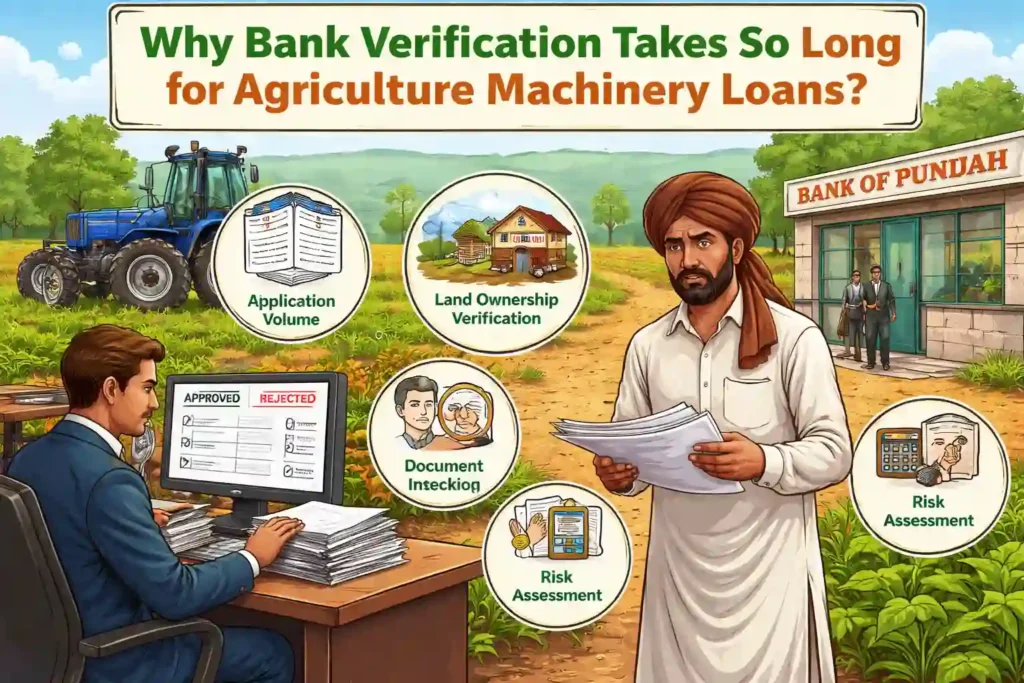
Understanding the Importance of Bank Verification
Before approving any loan, especially high-value agriculture machinery loans like tractors, harvesters, planters, or precision farming equipment, banks must ensure:
- The applicant is genuine
- The land or business exists
- The applicant can repay the loan
- The machinery will be used properly
- There is no fraud or risk
Since the government covers interest in programs like CM High Tech, banks must follow strict monitoring rules. That is why verification is not a quick formality; it is a serious legal and financial process.

High Application Volume Increases Processing Time
The first major reason for delay is huge application traffic.
Every year, thousands of farmers apply for agriculture machinery loans. During subsidy schemes and programs like CMHighTech, the number of applications increases even more. When more people apply at the same time, banks face:
- Heavy workload
- More files to check
- Limited staff handling applications
Banks cannot simply approve applications in bulk without careful inspection. Therefore, high demand automatically increases processing time.

Why do banks take so long to approve a loan?
Banks take time to approve agriculture loans because they must carefully verify documents, confirm land ownership, check farming activity, and assess the applicant’s repayment capacity. Large numbers of applications, coordination with government departments, and field verification visits also slow down the process. Since agriculture machinery loans involve big amounts and government-supported schemes, banks must follow strict rules to ensure transparency, safety, and fair distribution.

Which bank gives the highest loan to agriculture?
In Punjab, the Bank of Punjab (BOP) is currently one of the leading banks providing high-value agriculture machinery financing under government schemes like the CM Punjab High Tech Farm Mechanization Finance Program. BOP offers large loan limits, easy repayment plans, and interest support under government initiatives. Other banks also provide agriculture loans, but BOP is most commonly preferred for modern agri-machinery financing due to its strong role in official programs.

What is the verification stage of a loan?
The verification stage of a loan is the process where the bank checks whether the applicant is eligible, genuine, and financially stable. During this stage, the bank verifies CNIC, land records, income or farming activity, bank statements, and other documents. Physical inspection of land or farm may also be done. Risk assessment teams review the case to ensure the loan can be safely approved. Once verification is completed successfully, the loan moves toward approval.
Detailed Documentation Checking Takes Time
Agriculture loans require multiple documents, and each document goes through strict checking. These include:
- CNIC verification
- Land ownership records (Fard / Registry)
- Crop record verification
- Income proof or farming activity proof
- NTN for agri entrepreneurs
- Bank statements (if required)
- Supplier quotations for machinery
If any document is missing, unclear, expired, or has discrepancies, the verification takes longer. In many cases, farmers upload blurred images, incomplete forms, or wrong documents, which further delays the process.
Land and Ownership Verification Is a Slow Process
Land verification is the biggest step that consumes maximum time.
Banks must confirm:
- The farmer actually owns land
- The land is not disputed
- Records match government databases
- The land is not already mortgaged in another loan
For this purpose, banks coordinate with:
- Land Revenue Departments
- Arazi Record Centers
- Tehsil / District offices
Government record verification itself takes time, especially in rural areas where digital records are not always updated.
Physical Verification and Field Visits Cause Delays
Another major reason is physical inspection.
Bank teams or assigned survey officers visit:
- The farmer’s home
- Farmland
- Existing machinery (if any)
They confirm:
- The farmer is real and active
- Land is under cultivation
- Machinery requirement is genuine
Scheduling these visits, traveling to rural locations, weather conditions, and staff limitations all add to the timeline. If the applicant lives in remote areas, the delay becomes even longer.
Financial Risk Assessment Is Mandatory
Banks cannot simply distribute millions of rupees without checking repayment ability.
They evaluate:
- Financial stability
- Previous loans
- Credit score (if applicable)
- Banking history
If the applicant has:
- Previous default record
- Unpaid loans
- Poor transaction history
Then approval takes longer or may face rejection. Risk departments take time to carefully study each case to avoid losses.
Third-Party and Government Coordination Slows the Process
Agriculture machinery loans involve multiple stakeholders:
- Bank of Punjab or other partner banks
- Government departments
- CM High Tech program management
- Machinery suppliers
- Insurance companies
Every application requires cross-verification among these parties. Any delay from one side slows down the entire process.
Policy Compliance and Audit Requirements
Since CM Punjab High Tech Farm Mechanization Finance Program is a government-supported scheme, strict compliance rules apply.
Files are prepared in a way that they can be audited anytime. Banks must ensure:
- Zero fraud
- Transparent allocation
- Legal compliance
- Program eligibility enforcement
This makes verification slower but safer for the government and farmers both.
Common Reasons Why Farmer Applications Get Delayed
Many delays are caused by applicants themselves. Common mistakes include:
- Incomplete application forms
- Wrong mobile number or email
- Missing documents
- Fake or edited land papers
- Applying without eligibility
- Late document submission
If any clarification is needed, banks contact the applicant, which also adds extra days or weeks.
COVID, Seasonal Workload, and Administrative Slowdowns
Sometimes delays happen due to circumstances beyond anyone’s control:
- Government holidays
- Seasonal workload in banks
- Policy updates
- System upgrades
- Technical glitches
During harvesting seasons, both farmers and agriculture institutions get extremely busy, affecting processing speed.
How Long Does Bank Verification Normally Take?
On average, agriculture machinery loan verification may take:
- 2 to 4 weeks in simple cases
- 1 to 2 months in detailed cases
- Sometimes even longer if land disputes or document issues exist
Patience is important because banks are handling sensitive financial approvals.
How Farmers Can Speed Up Their Loan Approval
Good news — you can reduce delays by following simple steps:
✔ Submit Complete & Clear Documents
Avoid blurred pictures. Submit fresh and valid papers.
✔ Ensure Correct Land Records
Update records before applying.
✔ Provide Correct Contact Details
So the bank can reach you.
✔ Cooperate During Physical Verification
Be available when bank teams visit.
✔ Avoid Misrepresentation
Do not submit fake or edited documents.
✔ Keep Follow-Up But Politely
Visit the bank branch if needed.
Final Words – Verification Takes So Long for Agriculture Machinery Loans
Bank verification for agriculture machinery loans may feel slow, but it is necessary for transparency, safety, and fairness. Programs like the CM Punjab High Tech Farm Mechanization Finance Program are designed to support farmers, but careful verification ensures that only genuine and deserving applicants receive benefits.
Delays happen due to documentation checks, land verification, physical inspection, risk evaluation, and coordination between multiple organizations. Farmers who submit complete, genuine, and clear information usually experience faster approval.


